
Access control system troubleshooting in HOA gate systems requires matching what the board observes to what is actually failing mechanically or electrically, and in most cases, the visible symptom is not the root cause. For property managers in Sarasota who have described a gate problem to a service provider and received a vague answer, this guide provides the diagnostic vocabulary and symptom-to-cause framework to have a more informed conversation and make better decisions about repair, replacement, and maintenance.
7 HOA Gate Failures: What You See, What It Means, and What to Do
Failure 1: The Gate Reverses Mid-Cycle Without Being Commanded To
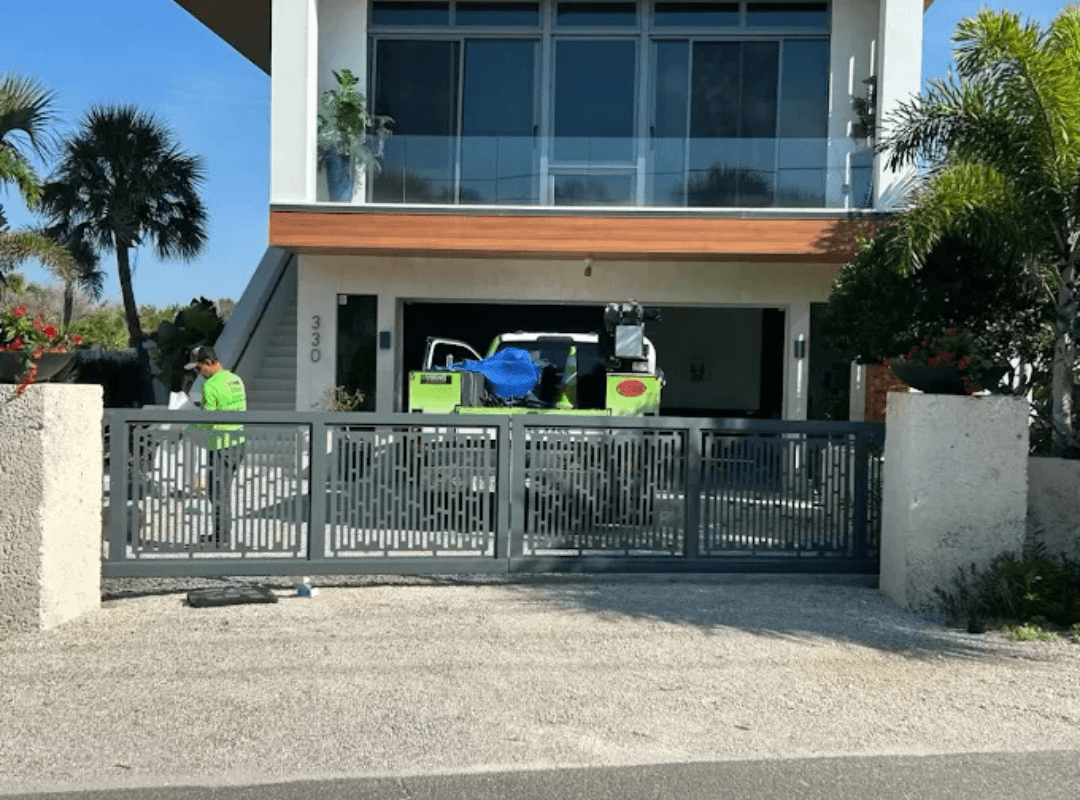
What the board observes: The gate begins to open or close normally, then reverses direction before completing the cycle, without any obstruction in the path.
What it typically means: A safety device is triggering incorrectly. Under UL 325, every automated gate operator must include entrapment protection: photo eyes, safety edges, or loop detectors. When these devices malfunction, shift out of alignment, or detect false inputs from environmental interference, the operator interprets it as an obstruction and reverses. Salt air corrosion on photo eye contacts and UV degradation on sensor wiring are the most common causes in Sarasota’s coastal environment.
What action it requires: A qualified technician needs to test each safety device individually, check alignment, inspect wiring for corrosion, and confirm that the sensor is not producing false inputs before clearing the gate for normal operation. This is a UL 325 compliance issue, not a nuisance fault to reset and ignore.
Failure 2: Resident Fobs and Keypads Work Inconsistently
What the board observes: Some residents report their fobs or PIN codes work intermittently, the gate opens on the second or third attempt, or fails to respond at certain times of day.
What it typically means: The control board or antenna circuit is degrading. In Sarasota’s humid, salt-air environment, solder joints and relay contacts on the control board corrode over time, producing intermittent signal processing failures. Antenna connections that have loosened from vibration or moisture intrusion produce similar symptoms. A fob that works 80 percent of the time is not a fob problem; it is a control board or antenna problem presenting early.
What action it requires: Control board inspection, antenna connection check, and cleaning of corroded contacts. If the board is approaching the end of its service life or shows significant corrosion, proactive replacement is more cost-effective than repeated service calls as the failures become more frequent.
Failure 3: The Gate Moves Slower Than It Used To
What the board observes: The gate that used to open in four seconds now takes eight or more. Residents notice. The operator sounds the same, but the movement is noticeably slower.
What it typically means: Motor strain from lubrication deficit, worn drive components, or misalignment creating mechanical resistance. As lubricants break down in Florida’s heat, a process that accelerates significantly in summer, the motor works harder to move the same load. Worn rollers and misaligned track add resistance that compounds the problem. This is one of the earliest and most reliable indicators of a system approaching a more serious failure.
What action it requires: Full lubrication service, drive component inspection, and track alignment check. Caught early, this is a straightforward maintenance visit. Left unaddressed, it becomes motor burnout and a full operator replacement.
Failure 4: The Gate Stops Mid-Cycle and Will Not Complete the Movement
What the board observes: The gate opens or closes partway and stops. It does not reverse; it simply halts. Cycling the operator restarts it, but it stops again at the same point.
What it typically means: A limit switch is failing or has shifted out of calibration. Limit switches tell the operator when the gate has reached its fully open or fully closed position. When a limit switch degrades, the operator receives an incorrect signal mid-travel and stops as if the gate has completed its cycle. High-cycle HOA applications wear limit switches faster than any other mechanical component.
What action it requires: Limit switch inspection, calibration, and replacement if worn. This is a targeted repair, not a system-level failure, but it will not resolve itself and will become more frequent until the switch is replaced.
Failure 5: The Intercom or Call Box Is Not Connecting Reliably
What the board observes: Visitors press the intercom button, and residents either do not receive the call, hear static, or cannot release the gate after answering.
What it typically means: For telephone-based call box systems, the issue is often a degraded telephone line connection or a control board relay that has failed to close the gate release circuit. For newer cellular or IP-based intercom systems, the issue may be a connectivity disruption, a firmware issue, or a corroded connection at the intercom panel. In Sarasota’s coastal environment, intercom panels mounted in direct exposure to salt air deteriorate faster than inland installations.
What action it requires: For telephone entry systems, line quality testing and control board relay inspection. For cellular or IP-based systems, connectivity verification, firmware check, and panel connection inspection. If the system is more than eight years old and experiencing recurring intercom failures, a platform upgrade is worth evaluating against continued repair costs.
Failure 6: The Gate Operates Normally, But the Access Log Shows Unauthorized Entry Events
What the board observes: The gate appears functional, but the access control activity log shows entry events at times when no authorized credentials were used, or the log shows credentials that belong to former residents who should have been deactivated.
What it typically means: A credential management failure. Former resident credentials that were not properly deactivated remain active in the system. In some cases, shared PIN codes have been distributed to unauthorized individuals. This is not a hardware problem; it is an access control maintenance and support failure at the administrative level.
What action it requires: Full credential audit, deactivation of all former resident and expired vendor credentials, and implementation of a credential management protocol for future move-ins and move-outs. For HOA communities, this process should be part of a formal access control maintenance schedule, not a reactive task triggered by a security concern.
Failure 7: The Gate Fails Completely After a Power Outage or Storm
What the board observes: The gate worked normally before the storm or outage. After power is restored, it does not respond, or it responds partially with erratic behavior.
What it typically means: Power surge damage to the control board or battery backup exhaustion followed by incorrect restart behavior. Florida’s storm events frequently produce voltage spikes that bypass surge protection on aging systems. A control board that sustains surge damage may appear to function normally at first and then produce escalating failures over the following days as damaged components continue to degrade.
What action it requires: Control board inspection under load, surge protection assessment, and battery backup capacity test. Do not assume the system is functioning correctly because it appears to respond. Have a technician assess the control board after any significant storm event before declaring the system operational.
What Not to Do: Common Responses That Make Problems Worse
| Common Board Response | Why It Makes It Worse | Do This Instead |
|---|---|---|
| Cycle power to reset after a fault | Clears the fault code without diagnosing the cause will often result in the fault returning, often more frequently | Document the fault and call for a diagnostic before resetting |
| Bypass a safety sensor to keep the gate running | Creates a UL 325 non-compliant system and direct liability exposure | Take the gate offline if necessary and schedule emergency repair |
| Ignore intermittent failures because the gate mostly works | Intermittent failures are progressive; they become full failures, usually at the worst possible time | Schedule a diagnostic at the first sign of intermittent behavior |
| Assume a fob failure is a fob problem | Usually, a control board or antenna issue, replacing fobs does not fix the underlying cause | Test the control board and antenna before replacing credentials |
For HOA communities in Sarasota that need professional access control system troubleshooting and repair, our gate repair services include a full diagnostic assessment before any repair work begins. For communities that want to prevent these failures before they occur, our HOA preventive maintenance plan is built specifically for community gate infrastructure. For an overview of the full range of gate and access control services we offer, and for HOA-specific programs, visit our HOA gate services page.
Frequently Asked Questions
What is the most common access control system troubleshooting issue in HOA gate systems?
Intermittent credential failures and fobs and keypads that work inconsistently are the most frequent troubleshooting issues we diagnose in Sarasota HOA communities. In most cases, the root cause is a degrading control board or corroded antenna connection rather than a credential or programming problem. Safety sensor misalignment causing unexpected gate reversals and limit switch wear causing mid-cycle stops are the next most common issues, both of which are caught reliably during scheduled maintenance visits before they escalate into full failures.
Should an HOA gate be taken offline if a safety sensor is malfunctioning?
Yes, if the safety sensor cannot be repaired or bypassed safely. Under UL 325, operating an automated gate with a malfunctioning entrapment protection device creates a non-compliant system and direct liability exposure for the HOA. If a qualified technician cannot restore the safety device to proper function immediately, taking the gate offline and implementing a manual access procedure is the correct response, not bypassing the sensor to keep the gate cycling.
How does Florida’s climate affect access control system troubleshooting?
Sarasota’s salt air, heat, and humidity accelerate the failure modes that access control system troubleshooting addresses most frequently. Salt air corrodes control board contacts, relay components, and antenna connections faster than in inland climates. Heat degrades wiring insulation and lubricants. Humidity promotes moisture intrusion into operator housings that are not properly sealed. These environmental factors mean that HOA gate systems in coastal Sarasota require more frequent service intervals and more proactive corrosion management than national maintenance guidelines suggest.
Schedule a Gate System Diagnostic
24/7 Emergency Gate Service: 229.251.3066 | Main Office: (941) 349-4455 | Email: info@sarasotagate.com