
Commercial gate installation in Sarasota requires a fundamentally different specification process than residential installation; operator cycle ratings, duty cycle classifications, UL 325 entrapment protection requirements, and Sarasota County permitting all determine whether a commercial gate system performs reliably for a decade or fails within 18 months. The most expensive mistake business owners and property managers make is treating commercial gate installation as a scaled-up version of a residential project. It is not, and the consequences of that misunderstanding show up quickly on a high-traffic commercial property.
This guide covers the full commercial gate specification process from a contractor’s perspective, what the decisions are, why they matter, and what separates a system that serves your property from one that becomes a recurring maintenance liability.
The Commercial Gate Specification Process: What Every Decision Depends On
Step 1: Traffic Volume Assessment – The Number Everything Else Is Built Around
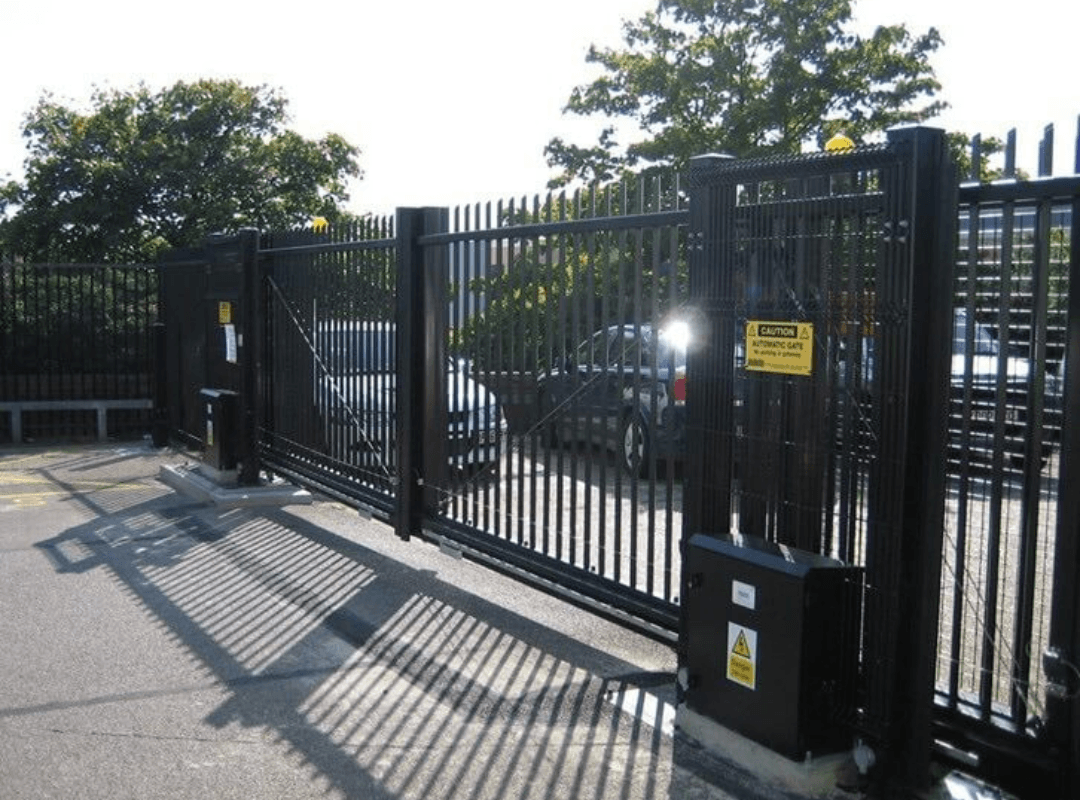
Every commercial gate specification begins with one question: how many times per day will this gate cycle? A cycle is one complete open and close sequence. A small office park may cycle 50 times per day. A logistics facility, apartment complex, or commercial parking structure may cycle 300 to 500 times per day or more.
This number determines the operator. Every gate operator is rated for a specific cycle volume and duty cycle, the percentage of each hour the operator can run without overheating. An operator running beyond its rated duty cycle will overheat, wear prematurely, and fail well before its projected service life. Getting the cycle count right at the specification stage is the most important decision in the entire project.
The Most Common and Costly Mistake in Commercial Gate Installation
The scenario we see most frequently on commercial service calls in Sarasota is a residential-grade or light-commercial operator installed at a property with commercial-level traffic. The operator was specified based on purchase price rather than cycle capacity, and by months 14 to 18, the motor is straining, the gearbox is showing wear, and the control board is producing intermittent failures.
By month 24, the operator requires replacement, at a cost that significantly exceeds the difference between a properly rated commercial operator and the undersized unit would have been at installation. The business owner spent less on day one and more over two years than if the specification had been done correctly from the start.
Commercial vs. Residential Gate Operators: How They Actually Compare
| Factor | Residential-Grade Operator | Commercial-Grade Operator |
|---|---|---|
| Typical cycle rating | 25–50 cycles/day | 100–continuous duty |
| Duty cycle | 20–30% per hour | 50–100% per hour |
| Motor class | Light-duty, intermittent | Heavy-duty, continuous |
| Gearbox construction | Plastic or light alloy | Heavy steel or cast iron |
| Typical application | Residential driveway, low-traffic HOA | Commercial lot, industrial facility, high-traffic HOA |
| Expected service life (proper use) | 7–10 years | 10–15+ years |
| Expected service life (misapplied) | 12–24 months | N/A – properly specified |
UL 325 Compliance: Not Optional, Not Negotiable
Every automated gate operator installed in the United States must comply with UL 325, the Underwriters Laboratories safety standard that requires entrapment protection on all automated gate systems. For commercial installations, this means photo eyes, safety edges, loop detectors, or a combination of these devices, installed and configured correctly for the gate type and application.
A commercial gate installation that does not include properly configured UL 325 safety devices is non-compliant from day one. For business owners and property managers, a non-compliant installation creates direct liability exposure if an entrapment incident occurs. Confirm that any contractor you engage specifies and installs compliant safety devices as a standard part of the project, not an upsell.
Sarasota County Permitting: What the Process Involves
Commercial gate installation in Sarasota County typically requires a permit, and the installation must pass inspection before the system is placed into service. The permitting process involves submitting plans that include gate dimensions, operator specifications, safety device configurations, and electrical connection details.
Working with a contractor who is familiar with Sarasota County’s permitting requirements eliminates the most common source of project delays, incomplete or incorrect permit applications that require resubmission and extend the timeline by weeks. Ask any contractor you are evaluating whether they have pulled commercial gate permits in Sarasota County and how recently.
Access Control Platform Selection for Commercial Properties
The access control system behind a commercial gate is not a secondary decision. For most commercial properties, the access control platform determines how employees, vendors, contractors, and visitors enter the property and how that entry is logged, managed, and audited.
Commercial access control options range from basic keypad or key fob systems for smaller properties to cloud-managed platforms with video intercom, license plate recognition, and activity logging for larger facilities. The right platform depends on the number of users, the volume and variety of visitor traffic, and whether remote management is a requirement for the property manager.
For Sarasota business owners evaluating commercial gate options, our commercial and industrial gate installation page covers the full scope of what we install and service. For an overview of custom gate design and installation for commercial properties specifically, visit our gate design and installation page. For the full range of gate and access solutions across industries we serve in the Sarasota area, visit our industries page. For local service coverage details, our Sarasota service page covers what we offer in your area.
Frequently Asked Questions
What is the difference between commercial and residential gate installation?
The primary differences are operator capacity, duty cycle rating, safety device requirements, and permitting scope. Commercial gate operators are rated for significantly higher daily cycle volumes than residential units and are built with heavier-duty components for continuous or near-continuous operation. Commercial installations also require UL 325-compliant entrapment protection systems and typically require Sarasota County permits. Specifying a residential-grade operator for a commercial application is the most common and costly installation mistake in the industry.
Does commercial gate installation in Sarasota require a permit?
Yes, in most cases. Commercial gate installations in Sarasota County require a permit and inspection before the system is placed into service. The permit application must include operator specifications, safety device configurations, and electrical connection details. Working with a contractor who is familiar with Sarasota County’s commercial permitting process is the most reliable way to avoid application delays that extend project timelines.
How do I know if my commercial property needs a heavy-duty gate operator?
If your property generates more than 50 gate cycles per day, which includes most commercial parking facilities, multi-tenant office buildings, logistics properties, and apartment complexes, a commercial-grade or heavy-duty continuous-duty operator is the appropriate specification. A qualified installer will assess your traffic volume, gate weight, and operational requirements before recommending a specific operator. Never rely solely on a contractor who recommends an operator based on price without first establishing your daily cycle count.
What access control system is best for a commercial gate in Sarasota?
The right access control platform depends on the number of users, visitor traffic volume, and whether remote management is required. For smaller commercial properties with stable user populations, a keypad or fob system may be sufficient. For larger facilities with active visitor and vendor traffic, a cloud-managed platform with video intercom and activity logging provides the audit trail and remote management capability that most commercial property managers need. A site assessment with a qualified installer is the most reliable way to match the right platform to your specific operational requirements.
Request a Free Commercial Gate Assessment
24/7 Emergency Gate Service: 229.251.3066 | Main Office: (941) 349-4455 | Email: info@sarasotagate.com