
HOA gate access control in Sarasota carries legal and operational responsibilities that most boards do not fully account for until a storm tests them. Under Florida Statute 720 and UL 325 safety standards, HOA boards are responsible for ensuring that community gate systems function reliably during evacuations, power outages, and emergency vehicle access events. A gate that fails during a hurricane is not just an inconvenience. It is a documented liability exposure and, in the worst cases, a life-safety issue.
This post gives HOA boards and property managers a practical pre-storm checklist covering the access control maintenance steps that determine whether your community gate performs when it matters most or becomes the reason emergency vehicles cannot get in.
Before vs. After: What Storm Preparedness Actually Looks Like in Practice
Consider two HOA communities in Sarasota County facing the same Category 2 storm. Both have automated gate systems installed within the last five years. One board scheduled a pre-storm access control inspection six weeks before hurricane season. The other deferred it.
Community A – Prepared: The pre-storm inspection identified a battery backup unit with 40% capacity. It was replaced before the storm. When the power grid went down for 36 hours, the gate cycled normally. Emergency vehicles accessed the community without delay. Residents evacuated and returned without incident.
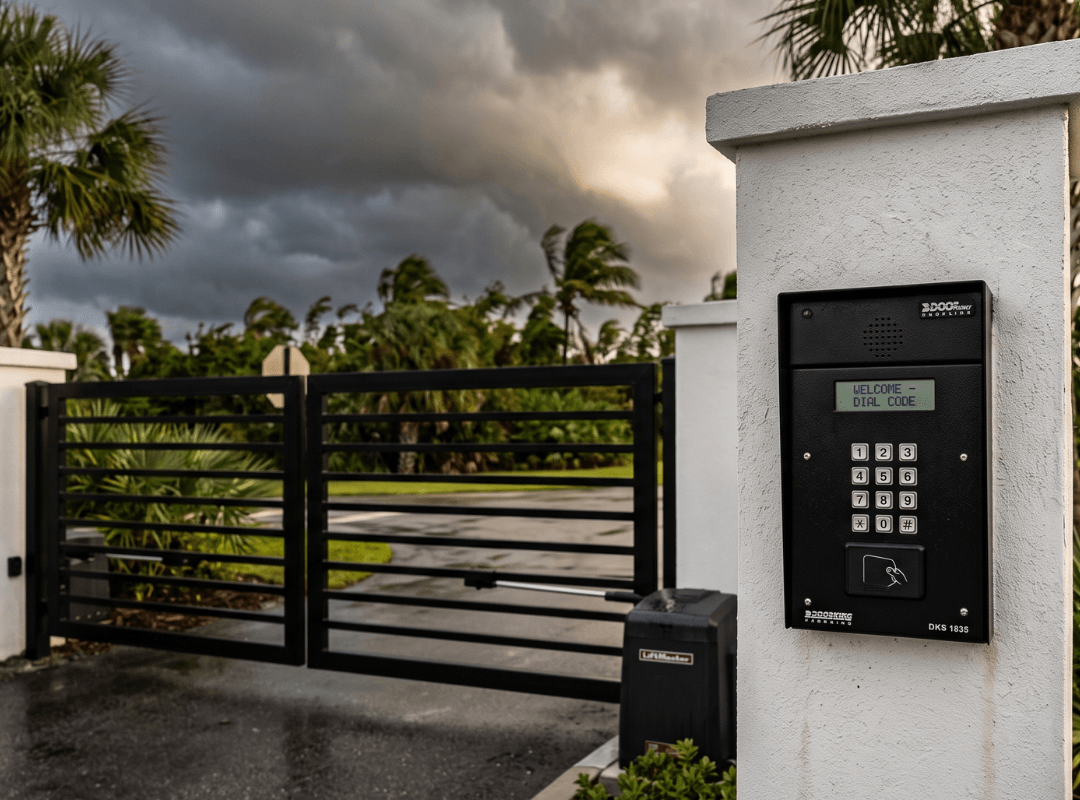
Community B – Unprepared: The battery backup failed within four hours of the outage. The gate defaulted to a fail-secure closed position. Emergency vehicles were delayed at the entry while staff attempted a manual override. Two residents who had not evacuated could not get back in after the storm passed. The board received formal complaints and a legal inquiry regarding emergency access obstruction.
The difference between these two outcomes was not the gate system. It was the pre-storm inspection that one board scheduled, and one did not.
Step 1: Test the Battery Backup System
Battery backup is the single most important component to verify before hurricane season. Florida’s storm-related power outages regularly last 24 to 72 hours. A battery backup that passed its last inspection may have degraded significantly in the months since, particularly in Sarasota’s heat, which accelerates battery capacity loss.
A proper battery test is not a visual check; it requires a load test under simulated power loss conditions to confirm the unit can sustain full gate operation for the required duration. Most manufacturers specify a minimum backup duration; verify your system meets that specification under actual load, not just resting voltage.
Step 2: Verify Knox Box Functionality and Emergency Access Configuration
Florida HOA communities are required to maintain reliable emergency vehicle access. A Knox Box, the secure key storage device that allows fire, EMS, and law enforcement to access a property without resident assistance, must be properly installed, stocked with current keys or access credentials, and confirmed functional before storm season.
Knox Box failures are more common than most boards realize. Keys become outdated when access control systems are updated. Boxes corrode in coastal environments. And the fire department’s master key must match the box on your property. Verify all of this with your local fire district before June 1.
Step 3: Perform a Full UL 325 Safety Device Check
Under UL 325, every automated gate operator in the United States must include functioning entrapment protection: photo eyes, safety edges, or loop detectors, depending on the gate configuration. These devices degrade over time and are particularly vulnerable to Florida’s salt air, UV exposure, and storm debris.
A pre-storm safety device check should confirm that photo eyes are aligned and triggering correctly, safety edges are responsive across the full gate travel, and loop detectors are detecting vehicle presence reliably. A gate with a failed safety device is a UL 325 compliance violation and an active liability issue regardless of storm season.
Step 4: Inspect Operator Housing for Water Intrusion Points
Storm-driven rain enters operator housings through corroded seals, cracked enclosures, and improperly sealed conduit entries. Water intrusion during a storm can destroy a control board in hours, and a control board failure during an active storm event means no gate operation until a technician can respond after the storm passes.
Inspect all operator housings for cracked or missing seals, signs of previous water intrusion (rust streaks, corrosion on internal components), and conduit entries that are not properly sealed with weatherproof fittings. Address any intrusion points before the first significant rain event of the season.
Step 5: Confirm Fail-Safe vs. Fail-Secure Configuration
Every automated gate can be configured to default to either an open (fail-safe) or closed (fail-secure) position when power is lost and backup is exhausted. For HOA communities, this configuration decision has direct implications for both security and evacuation safety.
A gate that defaults closed during an extended outage may trap residents or block emergency access. A gate that defaults open removes the community’s perimeter security for the duration of the outage. Boards should review their current configuration, understand what it means operationally, and confirm it reflects a deliberate decision rather than a default left over from installation.
Step 6: Test All Access Credentials Under Backup Power
Resident fobs, keypads, and mobile app access should all be tested under backup power conditions before storm season. Some access control platforms behave differently when running on battery; credential databases may not sync, intercom systems may not function, and remote management interfaces may go offline.
Identify which features remain operational under backup power and communicate clearly to residents what entry method to use during an extended outage. Distributing this information before a storm is significantly more effective than attempting to communicate it during one.
For communities that want a qualified technician to work through this checklist before hurricane season, our HOA gate services include pre-storm access control inspections across Sarasota and the surrounding region. For communities on our preventive maintenance plan, pre-storm inspections are prioritized ahead of non-member service calls. For a full overview of gate and access solutions across all property types, visit our industries page.
Frequently Asked Questions
Is an HOA legally responsible for gate access control failures during a hurricane in Florida?
Under Florida Statute 720, HOA boards have authority and responsibility over common area infrastructure, including entry gates. While specific liability outcomes depend on the circumstances and legal counsel’s assessment, boards that fail to maintain functioning emergency access, including battery backup, Knox Box access, and UL 325-compliant safety devices, face significantly greater exposure when failures occur during storm events. Pre-storm documentation of inspection and maintenance work is the most effective way to demonstrate due diligence.
How long should a gate battery backup last during a Florida power outage?
Most commercial-grade gate operators with properly maintained battery backup can sustain full operation for 24 to 72 hours, depending on cycle volume and battery condition. However, battery capacity degrades over time; a unit that tested at full capacity 18 months ago may be operating at significantly reduced capacity today. Annual load testing under simulated power loss conditions is the only reliable way to confirm actual backup duration before a storm event.
What should an HOA do if the gate fails during a hurricane?
If a gate fails during an active storm, the immediate priority is securing the entry point manually if the gate is stuck open and activating any emergency override to clear the gate path if it is stuck closed. Do not attempt to operate a damaged gate through the normal operator cycle after a storm, debris impact, flooding, or structural shift, as these conditions can create additional damage or safety hazards. Document the failure with photos before any repair work begins, and contact a qualified service provider as soon as safe access is available. Our 24-hour emergency line at (229) 251-3066 is available around the clock for post-storm response.
How far in advance should an HOA schedule a pre-storm gate inspection in Sarasota?
Six to eight weeks before the start of hurricane season, which officially begins June 1, is the recommended window for scheduling a pre-storm access control inspection. This allows adequate time to source and install replacement components if the inspection identifies deficiencies, and to test repaired systems before the first significant storm event of the season. Communities that wait until May or June to schedule inspections frequently encounter parts delays and limited technician availability as demand peaks.
Schedule a Pre-Storm Gate Inspection
24/7 Emergency Gate Service: 229.251.3066 | Main Office: (941) 349-4455 | Email: info@sarasotagate.com