
High security gate installation in Florida means specifying gates, barriers, and access control against a defined threat, such as forced entry, vehicle ramming, or tailgating, rather than simply automating an entry. A standard automated gate meets UL 325 entrapment safety rules, but UL 325 says nothing about stopping a vehicle or an unauthorized person. This guide explains what separates high-security systems from residential and HOA gates, how to read crash ratings, and what property managers should ask before hiring an installer.
What Makes a Gate System High-Security: Specifications That Go Beyond Standard Automation
UL 325 Is a Safety Floor, Not a Security Rating
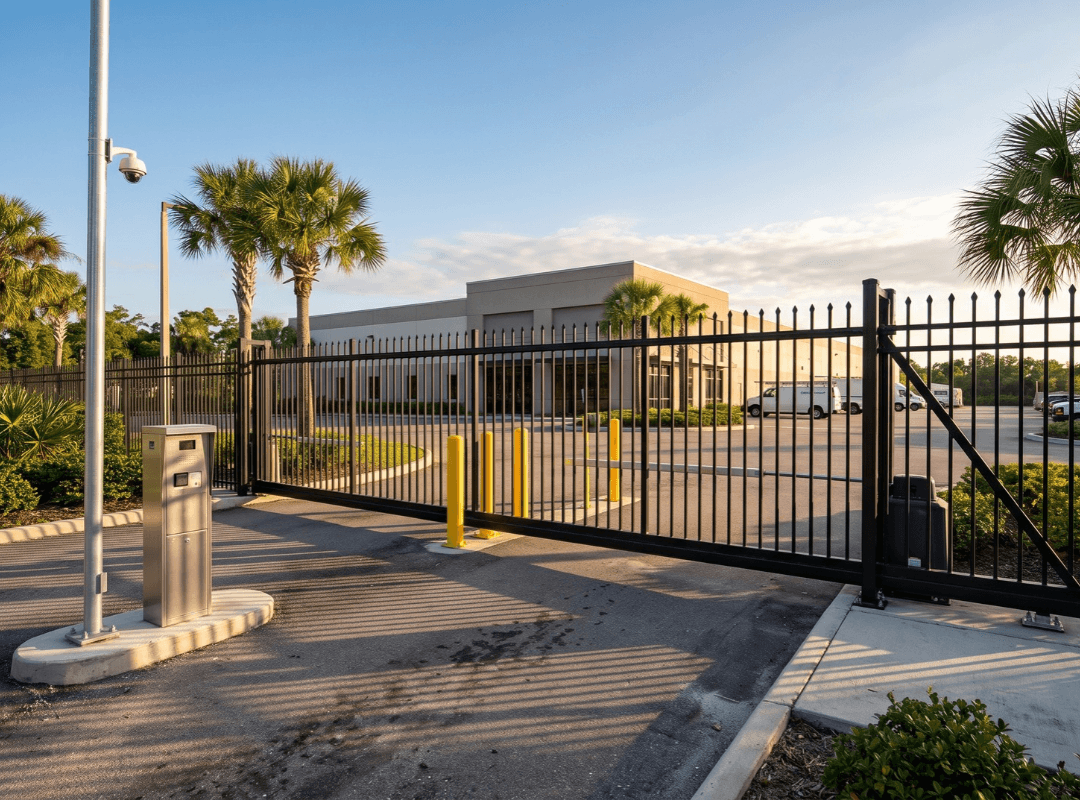
UL 325 governs how automated gates protect people from entrapment. It requires functioning photo eyes, safety edges, or loop detectors, and it applies to every automated gate operator in the country. It does not rate a gate’s resistance to forced entry or vehicle impact. A gate can be fully UL 325 compliant and still be pushed open by a pickup truck. High-security work starts with UL 325 compliance and then adds layers the standard never addresses, so property managers should treat compliance as the minimum requirement rather than proof of security.
Crash Ratings and ASTM F2656: Reading the Specification
ASTM F2656 is the test standard for vehicle barriers. A rating such as M30 or M50 identifies the test vehicle: a 15,000 pound medium-duty truck traveling at 30 or 50 miles per hour. A penetration rating from P1 to P4 then shows how far the vehicle travels past the barrier, with P1 meaning one meter or less. When a project calls for a crash rating, the full assembly must be tested and rated, including the foundation and operator, not just the barrier panel. Ask any installer for the manufacturer’s test documentation and foundation requirements, and confirm the rating applies to the exact configuration being proposed.
Access Control That Stops Tailgating and Verifies Identity
Tailgating, where a second vehicle or person follows an authorized one through an open gate, is the most common way secure entries are bypassed. High-security systems address it with presence detection, short open and close cycles, interlocked vehicle sally ports, and turnstiles at pedestrian entries. Credential verification moves beyond a single keypad code to multi-factor methods, such as a card plus PIN or a biometric reader, with audit logs that record every entry. Our access control systems page covers the platforms involved.
Video Surveillance and System Integration
Cameras integrated with the gate controller turn an entry into a documented event. License plate recognition, video intercom, and event-triggered recording give security staff verification before the gate opens and evidence afterward. Integration matters more than the individual devices: a camera that is not tied to the access control log leaves staff matching timestamps by hand. Specify open protocols and confirm the system can export logs for audits.
Standard Gates vs. High-Security Specifications by Property Type
Use this comparison to see what a standard gate typically provides and what a high-security specification adds for each property category.
| Property Type | What a Standard Gate Typically Provides | What High-Security Specifications Add |
|---|---|---|
| HOA or residential community | Automated swing or slide gate, keypad or fob entry, UL 325 safety devices | Video intercom, credential audit logs, and anti-tailgate detection at busy entries |
| Commercial office or retail | Automated gate with a card reader and basic call box | Multi-factor credentials, integrated cameras, and tamper-resistant hardware |
| Industrial and logistics | Heavy-duty slide or cantilever gate with remote control | Continuous-duty operators, license plate recognition, and anti-tailgate controls |
| Government and utility | Fenced perimeter with an access-controlled gate | ASTM F2656 crash-rated barriers, redundant power, and integrated surveillance |
| Correctional and secure facilities | Standard perimeter gate with keyed or manual override | Interlocked sally ports, security-grade operators, and engineer-specified standards |
Florida Conditions That Affect High-Security Gates
Florida adds its own demands. Salt air accelerates corrosion on operators, hinges, and control boards, so corrosion-resistant hardware and sealed enclosures extend service life. Hurricane season calls for backup power that keeps the gate operating through outages and a manual release procedure that staff know in advance. Permits and engineering requirements also apply, and crash-rated installations typically require a drawn foundation design. Security gate installation and automation in Fort Myers and Sarasota face the same coastal conditions, so durability should be part of any proposal.
Government and Correctional Facilities: Build to the Project Specification
Government, utility, and correctional gates are usually governed by specifications written by an engineer or the agency, and correctional facilities follow standards set by the Florida Department of Corrections along with the project documents. The installer’s job is to build to the document, not to substitute equivalents. Confirm that your contractor can read the specification, submit product data for approval, and document testing at completion.
For businesses comparing providers, our commercial gate installation page outlines the commercial and industrial work we handle. For local details, visit our Fort Myers service page or our Sarasota service page. You can also browse the full range of gate and access control services we offer throughout Southwest Florida.
Frequently Asked Questions
What is the difference between a standard gate and a high-security gate?
A standard gate automates an entry and meets UL 325 entrapment safety requirements. A high-security gate is specified against a defined threat and adds features such as crash-rated barriers, anti-tailgating controls, multi-factor credentials, and integrated video. The difference is the level of protection the specification is written to deliver.
Does UL 325 compliance make a gate secure?
No. UL 325 addresses entrapment safety for people near an automated gate. It does not measure resistance to forced entry or vehicle impact, so a compliant gate can still be defeated. Security requires additional specifications on top of UL 325.
What does an ASTM F2656 M30 rating mean?
M30 means the barrier was tested against a 15,000 pound medium-duty truck at 30 miles per hour. A penetration rating from P1 to P4 is added to show how far the vehicle traveled past the barrier. The rating applies only to the tested assembly, including its foundation.
Do high-security gates require permits in Florida?
Automated gate installations typically require a permit, and crash-rated barriers generally need engineered foundation drawings. Requirements vary by county and project type, so confirm them with the local building department and make sure your installer handles permitting as part of the scope.
Request a High-Security Gate Consultation
24/7 Emergency Gate Service: 229.251.3066 | Main Office: (941) 349-4455 | Email: info@sarasotagate.com