
Automatic gates in Sarasota HOA communities fail gradually, and the boards that catch the warning signs early pay significantly less than those that wait for a full system failure. If your community gate is showing any of the five signs below, a professional inspection is not optional. It is the decision that separates a manageable repair from an emergency call at midnight with a gate stuck open and a community perimeter unsecured.
As a provider of HOA gate services throughout Sarasota and the surrounding region, we diagnose these issues every week. Here is what they look like in practice and why each one matters.
The 5 Warning Signs HOA Boards Should Never Ignore
Sign 1: The Gate Is Moving Noticeably Slower
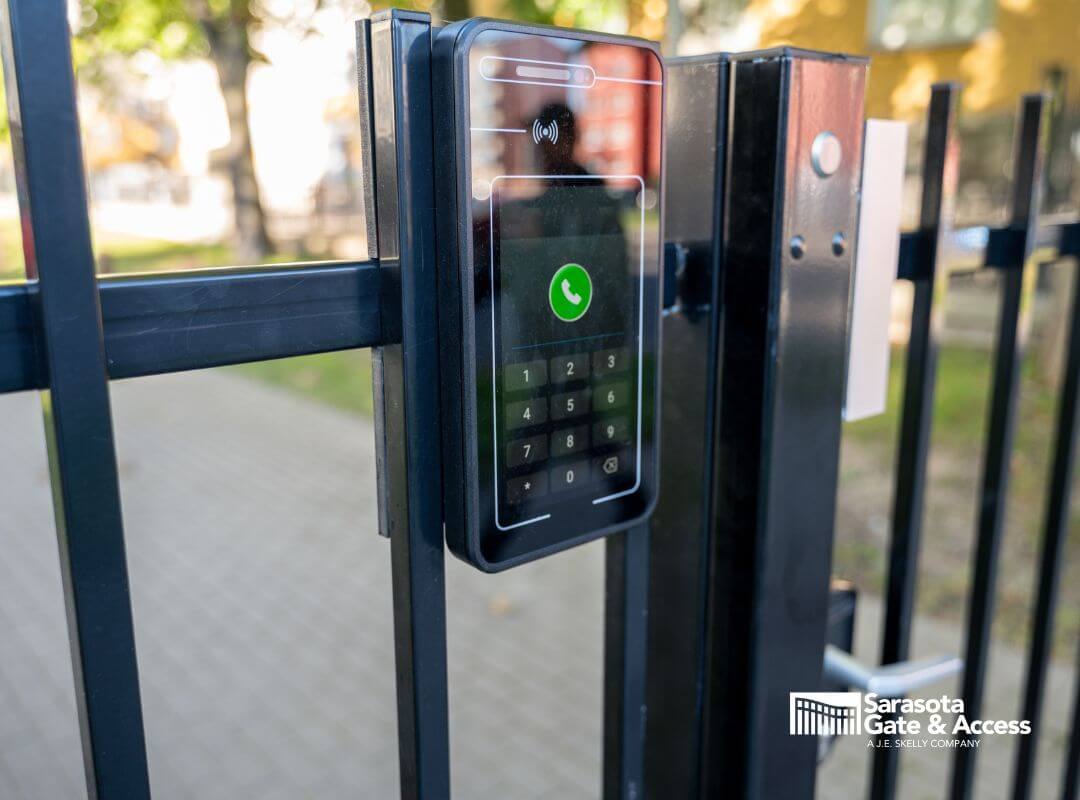
A gate that used to open in four seconds and now takes eight or ten is not just an inconvenience for residents; it is a symptom of mechanical strain. Slowing movement is one of the earliest indicators of motor wear, deteriorating drive components, or misaligned rollers creating resistance in the track.
In Sarasota’s climate, heat accelerates the breakdown of lubricants and rubber seals inside the operator housing. When those components degrade, the motor compensates by working harder to move the same load. Left unaddressed, a slow gate becomes a gate that stops mid-cycle, then a gate that does not open at all.
For HOA communities where the entry gate cycles hundreds of times per day, this wear accumulates fast. A lubrication service or bearing replacement caught early costs a fraction of what a full operator replacement runs after a motor burns out.
Sign 2: Grinding, Scraping, or Clicking During Operation
Automatic gates are not silent, but they should not be loud. Any new or worsening sound during gate operation is the system communicating that something is outside its normal operating tolerances.
- Grinding typically indicates worn gears or debris in the track
- Scraping usually means the gate is dragging, putting abnormal stress on the operator
- Clicking or popping during movement often points to a failing limit switch or a loose chain
For HOA gate systems in Sarasota, salt air corrosion on metal components is a frequent contributor to these sounds. Hardware that corrodes silently for months will announce itself audibly before it fails completely. Do not wait for the announcement to become a shutdown.
Sign 3: The Gate Reverses or Stops Without Being Commanded To
This is the sign that HOA boards most frequently underestimate, and the one with the most serious consequences if ignored.
When a gate reverses mid-cycle, stops unexpectedly, or refuses to close completely, it is almost always a safety device or sensor issue. Under UL 325, the federal safety standard governing all automated gate operators in the United States, every automated gate is required to include entrapment protection. When those sensors malfunction, the gate may behave erratically or, in certain failure modes, disable its own safety stops.
A gate that reverses without command is not just an operational problem. It is a liability issue for the HOA. Residents, vehicles, and visitors pass through that entry point constantly. A malfunctioning safety sensor must be diagnosed and corrected by a qualified technician, not bypassed, not ignored, and not reset by cycling the power and hoping it clears.
Sign 4: Access Credentials Are Failing Intermittently
When resident fobs stop working reliably, or the keypad requires multiple attempts to respond, boards often assume the issue is user error or a dead battery. In most cases it is neither.
Intermittent credential failures point to a deteriorating control board, antenna degradation, or wiring corrosion inside the operator housing. In Sarasota’s coastal environment, salt air works its way into electrical connections over time. What presents as a fob that works 80 percent of the time will eventually become a system that does not respond at all.
For HOA communities managing dozens or hundreds of resident credentials, a control board failure is not a minor inconvenience. It is a full access event that requires immediate attention. The time to inspect the control board is when residents start reporting inconsistencies, not after the system goes dark.
Sign 5: Visible Physical Damage to the Gate, Track, or Operator Housing
Florida storm season, delivery vehicles, and daily wear all contribute to physical damage on gate infrastructure. Bent track sections, cracked welds, a gate that sits lower on one side, or a dented operator housing that has allowed water intrusion are not cosmetic issues. They are structural ones.
Physical damage changes how load is distributed across the drive system. A gate running on a bent track is pulling the motor at an angle it was not engineered to handle. Over time, that misalignment transfers stress to bearings, gears, and mounting hardware; components that were designed for a level, straight load. Repairing structural damage early is almost always far less expensive than replacing the operator it destroys.
What Happens When You Call for a Professional HOA Gate Inspection
A qualified technician does not just look at the symptom. They work through the full system, testing the operator, inspecting every safety device, checking wiring and control board function, and assessing the gate structure for alignment and wear.
At Sarasota Gate & Access, every membership begins with a comprehensive Diagnostic Inventory Audit. Even if your system is not currently broken, we perform a top-to-bottom inspection to catalog your equipment, identify high-wear components before they fail, and optimize performance through lubrication, calibration, and software updates. We know exactly what parts your system needs before we ever leave our facility.
For HOA communities experiencing any of the five signs above, our professional gate repair services include a full diagnostic assessment before any repair work begins. For communities that want to stay ahead of failures entirely, our HOA preventive maintenance plan is built specifically for the demands of community gate infrastructure in Sarasota and the surrounding region. Members receive same-day priority service, a dedicated technician, and access to our 4,000 sq. ft. on-site parts inventory, which means repairs happen on the day of the call, not after waiting on a parts order.
For more on what HOA boards should know about gate system care in Sarasota, visit our Sarasota gate and access control service page.
Frequently Asked Questions
How do I know if my HOA gate needs repair or full replacement?
If the gate structure is sound and the operator is within its expected service life, most failures can be repaired rather than replaced. The clearest indicator that replacement is more cost-effective than continued repair is a pattern of recurring failures on the same components within a short timeframe. A qualified technician will assess your system and give you an honest recommendation based on equipment age, parts availability, and the cost trajectory of continued repair versus a planned replacement investment.
What is the most common HOA gate repair issue in Sarasota?
The most frequent issues we diagnose in Sarasota HOA communities are operator slowdown from lubrication and drive component wear, control board failures caused by wiring corrosion from Florida’s salt air and humidity, and safety sensor misalignment from physical impact or structural shift. All three are progressive, they develop over time and are reliably caught during routine maintenance visits before they escalate into emergency repair calls.
Can an HOA gate be repaired without disrupting community access?
In most cases, yes. Our technicians are experienced working on active community gate systems and can complete most repairs during off-peak hours to minimize disruption to residents. For repairs that require the gate to be taken offline, we coordinate with the board or property manager in advance and can implement a temporary access solution during the service window. Emergency repairs are handled as quickly as possible to restore full community access.
How often should an HOA automatic gate be professionally inspected in Florida?
For a primary community entry cycling dozens to hundreds of times per day, semi-annual professional inspections are the appropriate minimum. Florida’s climate, salt air, heat, UV exposure, and storm season accelerates wear on gate systems significantly compared to other regions. High-traffic HOA gates benefit most from quarterly service visits, and communities on a formal maintenance program consistently see lower total repair costs and longer equipment lifespans than those on a reactive service model.