
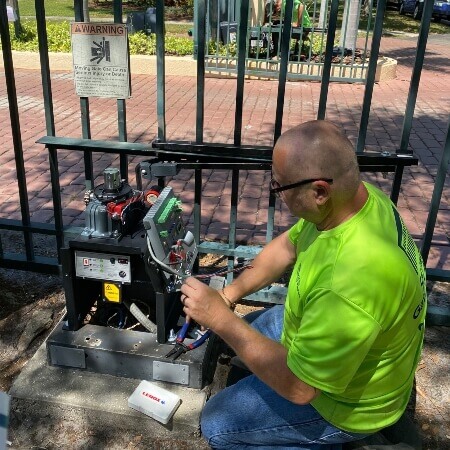
If you manage or own property with an automatic gate in Manatee County, you already know how much that entry point does every single day. It opens and closes dozens of times, weathers Florida’s heat and humidity, and takes the occasional hit from a vehicle or storm. Most gate problems do not appear overnight. They build slowly, and by the time the gate stops working entirely, the repair cost is almost always higher than it would have been if the issue had been caught early.
This guide covers the five most common warning signs that your automatic gate needs professional attention, plus what to expect from a community gate service call in Manatee County before the problem gets worse.
Sign 1: The Gate Is Moving Slower Than Usual
A gate that used to open in four seconds and now takes eight is not just an inconvenience. It is a symptom. Slowing movement is one of the earliest signs of motor strain, worn drive components, or misaligned rollers and hinges creating resistance.
In Florida’s climate, heat accelerates wear on rubber seals and lubricants inside the operator. When those components degrade, the motor works harder to move the same load. Left unaddressed, a slow gate becomes a gate that stops mid-cycle, then a gate that does not open at all.
If your gate has noticeably slowed, schedule a diagnostic before the motor burns out. A bearing replacement or lubrication service is a fraction of the cost of a full operator replacement.
Sign 2: You Are Hearing Grinding, Scraping, or Clicking Sounds
Automatic gates are not silent, but they should not be loud. Grinding typically points to worn gears or debris caught in the track. Scraping usually means the gate is dragging, which puts stress on the operator and the gate structure itself. Clicking or popping during movement often signals a failing limit switch or a loose chain.
Any new or worsening sound during gate operation deserves attention. These are mechanical systems with specific tolerances, and unusual noise is the system telling you something is outside those tolerances.
Sign 3: The Gate Reverses or Stops Without Being Commanded To (Do Not Ignore This One)
This is the sign most property managers underestimate, and it is the one that most often leads to a full system failure or a safety incident.
When a gate reverses mid-cycle, stops unexpectedly, or refuses to close completely without intervention, it is almost always a sensor or safety loop issue. Automatic gates are required by UL 325 safety standards to include entrapment protection. When those sensors malfunction, the gate may behave erratically or, in some configurations, override safety stops entirely.
A gate that reverses unexpectedly is not just an access control problem. It is a liability issue for HOA boards and property managers. Residents, vehicles, and guests are moving through that entry point. A malfunctioning safety sensor needs to be diagnosed and corrected by a qualified technician, not bypassed or ignored.
Sign 4: Remote Access and Keypads Are Inconsistent
Intermittent access failures are among the most frustrating gate problems because they are easy to dismiss. The gate opened fine yesterday, so maybe the fob just needed a new battery. But when access credentials stop working reliably, the cause is rarely that simple.
Inconsistent keypad or remote response can indicate a failing control board, antenna issues, wiring corrosion, or a power supply problem. In coastal Manatee County communities, salt air accelerates corrosion on electrical connections inside the operator housing. What starts as a fob that works 80 percent of the time will eventually become a gate that does not respond at all.
If multiple users are reporting access problems or the system requires multiple attempts to respond, it is time to have the control board and wiring inspected.
Sign 5: Visible Physical Damage to the Gate, Track, or Operator Housing
Florida storm season, delivery vehicles, and everyday wear all take a toll on gate infrastructure. Bent track sections, cracked welds, a gate that sits noticeably lower on one side, or a dented and water-compromised operator housing are all issues that compound over time.
Physical damage to the gate structure changes how load is distributed across the operator and drive system. A gate running on a bent track is pulling the motor at an angle it was not designed for. Over time, that misalignment transfers stress to bearings, gears, and mounting hardware that were designed for a straight, level load.
Address structural damage before it creates an operator failure. In many cases, repairing the track or rehinging the gate is a straightforward job. Replacing the operator because it wore out prematurely due to structural neglect is not.
What to Expect From a Professional Gate Repair Call in Manatee County
A qualified technician will start with a full diagnostic before recommending any repair. That means testing the operator, inspecting the safety devices, checking wiring and control board function, and assessing the gate structure for alignment and wear.
At Sarasota Gate & Access, we stock a large inventory of parts for the systems we service, including Cellgate, DoorKing, Viking, and LiftMaster. That means we are not waiting on shipping to complete most repairs. We also offer 24-hour emergency service for gated community entrance repair in Bradenton and throughout Manatee County when a gate failure cannot wait.
For communities already experiencing repeated repairs, our professional gate repair services include a full equipment assessment to determine whether continued repair or a system upgrade is the more cost-effective path forward.
If your community wants to get ahead of failures before they happen, our preventive maintenance program is designed specifically for HOAs and multi-resident properties. Members receive priority scheduling, preferred parts pricing, and a dedicated technician who knows their system. You can explore the full range of gate and access control services we offer, or review our HOA gate services for community-specific programs. For information on the systems and equipment we work with, visit our products page.
Frequently Asked Questions
How much does automatic gate repair cost in Manatee County?
Repair costs vary based on the issue, the system type, and the parts required. Minor repairs such as sensor adjustments, lubrication, or a limit switch replacement may run a few hundred dollars. Control board replacements or full operator swaps typically range from $800 to $2,500 or more depending on the unit. Catching problems early almost always reduces total repair cost significantly.
Can a gate repair company service my HOA’s existing system, or will I need a full replacement?
In most cases, existing systems can be repaired or upgraded without a full replacement. A qualified technician will assess your equipment and give you an honest recommendation based on the age of the system, parts availability, and the cost of continued repair versus a replacement investment.
Do you offer emergency gate repair in Bradenton and Manatee County?
Yes. We provide 24-hour emergency service for gated community entrance repair in Bradenton and throughout Manatee County. A gate failure that leaves a community unsecured or inaccessible cannot wait for a standard appointment window. Call us directly at 229.251.3066 for urgent repair needs.
How often should an automatic gate be serviced to prevent breakdowns?
For residential gates with moderate use, annual service is a reasonable baseline. For HOA and community gates that cycle dozens or hundreds of times per day, semi-annual or quarterly maintenance visits are more appropriate. High-frequency use gates in Florida’s climate should be on a formal maintenance program to extend equipment life and catch issues before they escalate.
FAST Response Time – 24 Hour Emergency Service – Call Now: 229.251.3066